Monstera deliciosa kaufen - 4 Angebote ab 30,00 €
Auch bekannt als: Monstera borsigiana, Monstera deliciosa borsigiana, Monstera deliciosa sierrana, Monstera lennea, Monstera lenneana, Philodendron anatomicum, Philodendron fenestratum, Philodendron pertusum, Tornelia fragrans

 Deutschland
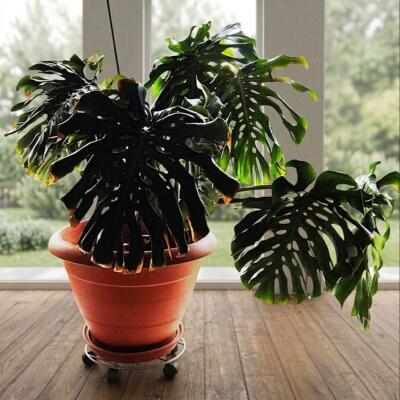
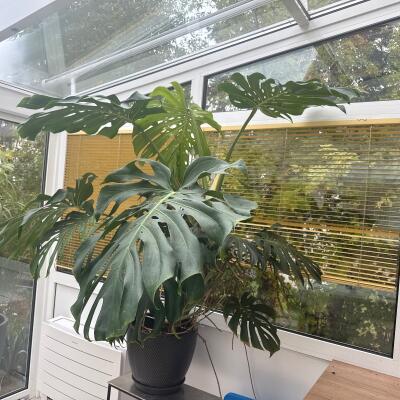

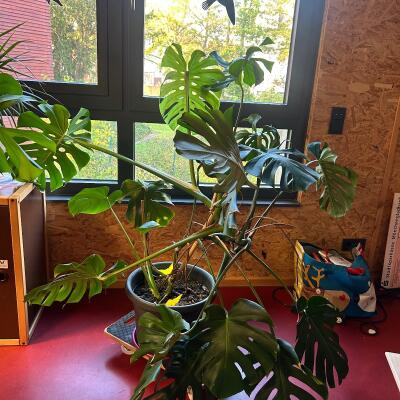

Artensteckbrief
- Akzeptierter Name
- Monstera deliciosa Liebm. Art
- Trivialnamen
- großes Fensterblatt, Köstliches Fensterblatt, Philodendron
- Reich
- Plantae
- Abteilung
- Tracheophyta
- Klasse
- Liliopsida
- Ordnung
- Alismatales
- Familie
- Araceae
- Gattung
- Monstera
- Lebensraum
- Terrestrial, Garden
- IUCN-Rote-Liste
- Nicht beurteilt
- Verbreitung
- East Africa; Galápagos Islands; Caribbean; Middle America; North America
- Erstveröffentlicht in
- Vidensk. Meddel. Naturhist. Foren. Kjøbenhavn 1: 19 (1849)
Bilder und Beobachtungen
For more details about the taxonomic comments and nomenclatural note see Cedeño-Fonseca et al. (2022). (Revision of Monstera (Araceae: Monsteroideae) of Central America)
Robust to massive herb, terrestrial or nomadic vine, appressed-climbing habit. SEEDLINGS: bearing foliage leaves. JUVENILE PLANTS: root climbers; stems brown to grayish, smooth or warty, cylindrical; internodes 7 – 12 cm long, 1 – 2 cm diam.; petiole distinct, dark green, smooth, 14 – 17 cm long, sheathed up to half their length; petiole sheath semi-deciduous; blades ovate to lanceolate, cordate at base, acuminate, coriaceous, 15 – 23 × 14 – 20 cm, not appressed to the phorophyte; fenestrations absent. ADULT PLANTS: root climbers; stems beige or whitish, smooth, cylindrical, internodes 1 – 9 cm in long, 3.0 – 5.5 cm diam., 0.3 – 1.6 times as long as wide; anchor roots whitish; feeder roots dark brown; petiole light green, warty or smooth, 40 – 110 cm long, sheathed up to half their length; petiole sheath deciduous; unsheathed portion flattened and winged adaxially, convex abaxially; geniculum warty, flattened adaxially and convex abaxially, 2 – 5 cm long; blades ovate to lanceolate, cordate to subcordate at base, acuminate, coriaceous, drying grayish or yellowish, 40 – 75 (112) × 40 – 55 (88) cm, 1.0 – 1.1 times longer than wide, decurrent-undulate over the geniculum, with 4 – 6 undulations of 5 – 7 mm wide; midrib flattened adaxially, convex abaxially, drying yellowish or blackish on both surfaces; primary lateral veins 6 – 11 per side, prominent on both surfaces, departing midrib at 85 – 90 °, drying yellowish, black or dark brown; secondary veins slightly prominent and reticulate; collective veins not visible; fenestrations round or ovoid, numerous, extending along the blade and near the midrib; margins pinnatilobed, 4 – 10 lobes per side, sometimes with a vein that runs along the margin which reaches the middle of the blade, occasionally marginal fenestrations can break the margin and cause a bifid lobe. INFLORESCENCES on ascending stems, 2 – 5 simultaneously at flowering time, arranged in the leaf axils or into cataphylls; peduncle 12 – 25 cm long, 2.5 – 3.0 cm diam., tuberculate; spathe short acuminate, bluish-green during development, yellowish externally and cream internally with revolute margins and closed (at apex) at anthesis, deciduous after anthesis, 12 – 23 × 7 – 13 cm, up to 5 cm longer than the spadix; spadix creamy-yellowish (both during development and at anthesis), 10 – 20 cm long, 2.5 – 3.0 cm diam., 3.4 – 5.8 times longer than wide; basal sterile flowers with a yellow stigmatic secretion, 5 – 8 mm long; fertile flowers 7 – 10 mm long; stamens 1.2 – 9.5 mm long, with laminar filaments; anthers 2.0 – 2.7 mm long; ovary quadrangular in longitudinal section, ribbed, 5 – 8 × 5 – 7 mm; style compressed and hexagonal, 2.5 – 3.0 × 4 – 7 mm; stigmatophore slightly cupuliform, 0.3 – 0.4 mm long; stigma circular and sunken, with transparent secretion; berries with a light green stylar cap during development, mature stylar cap yellowish; pulp white; seeds dark green, 5 – 10 mm long. (Revision of Monstera (Araceae: Monsteroideae) of Central America)
GBIF Secretariat (2023). GBIF Backbone Taxonomy. Checklist dataset https://doi.org/10.15468/39omei accessed via GBIF.org on 2026-11-23. Accessed via https://www.gbif.org/species/2868241 https://www.gbif.org/species/2868241 · Zuletzt aktualisiert 23.11.2026, 03:30